





Panchmukhi Diya: The Symbolism of Five Flames in Indian Philosophy

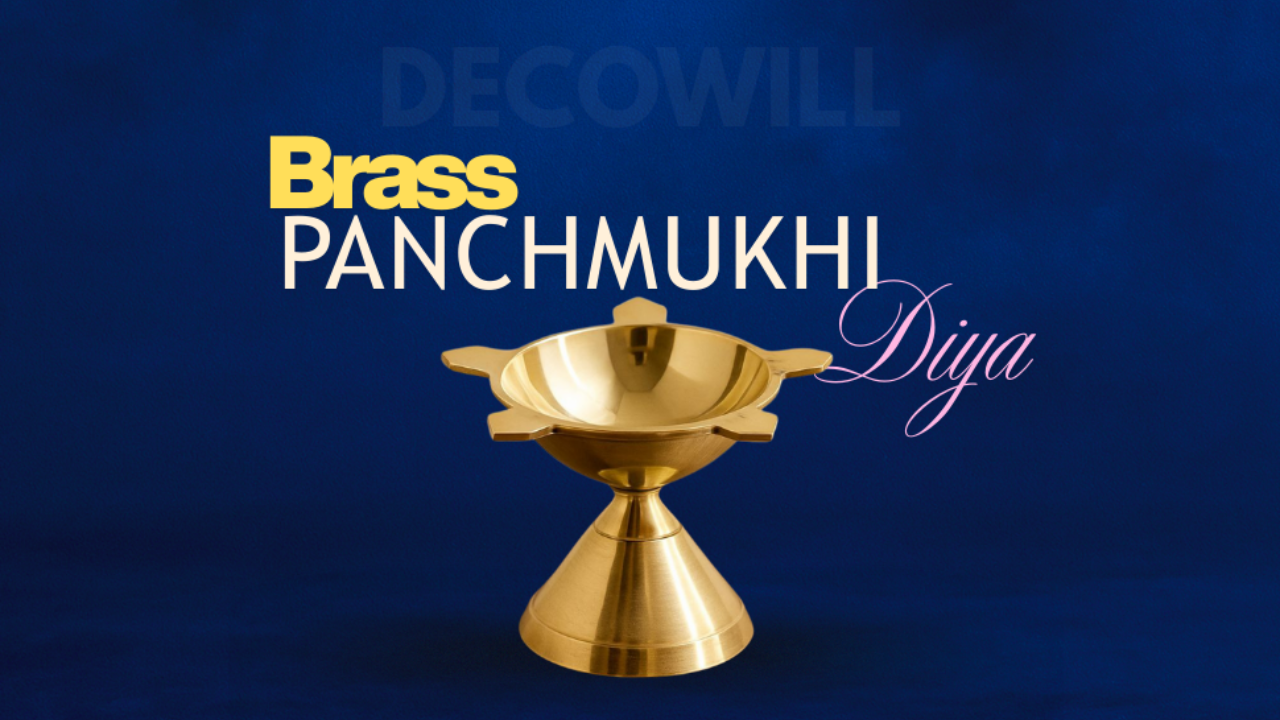
The five-faced (Panchmukhi Diya) lamp holds great significance in Indian homes. Five flames are lit in a circular arrangement in this lamp.
It is lit with great reverence in temples and homes.
Its five flames are also associated with the five faces of Panchmukhi Hanuman, which symbolize five divine qualities.
The Panchmukhi lamp may appear to be a simple lamp, but in Indian tradition, it is considered much more than a source of light.
The number five is considered very significant in Indian philosophy.
The influence of the number five can be seen in the five elements, the five senses, the five subtle qualities, and many other concepts of Indian philosophy.
This article will attempt to understand the significance of the Panchmukhi lamp.
- The Cosmos and the Living World
- Human Experience & Consciousness
- Spiritual Symbolism and Daily Life
The Cosmos and the Living World:
Five Fundamental Elements (Panch Mahabhut):
According to Indian philosophy, the entire cosmos is made up of five basic elements.
These five elements are called the Pancha Mahabhuta.
These five basic elements are as follows:
- Space
- Air
- Fire
- Water
- Earth
Fundamental Elements and Their Divine Associations
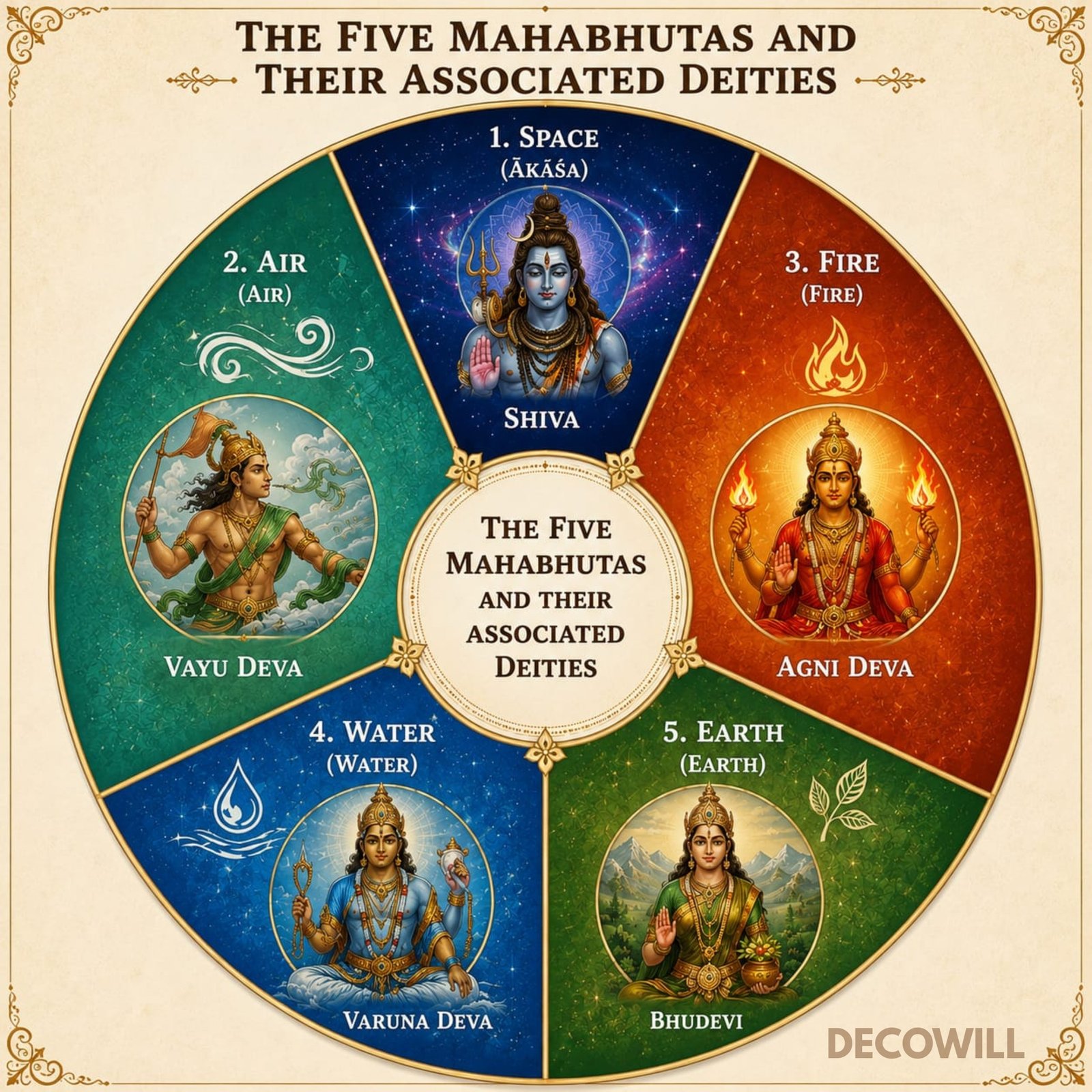
The five elements are believed to be associated with five deities. By lighting a five-faced lamp, devotees also honor the deities associated with these elements.
The Five Elements and Their Divine Associations
- Space (Akasha) → Shiva
- Air (Vayu) → Vayu Deva
- Fire (Agni) → Agni Deva
- Water (Jala) → Varuna
- Earth (Prithvi) → Bhudevi
Cosmos and our body:
Indian philosophy regards the human body as a microcosm of the larger universe.
According to Indian philosophy, the same five fundamental elements that constitute the cosmos are also present in all living beings. These elements not only shape physical existence but also give rise to the sensory experiences through which life perceives and interacts with the world.
The five fundamental elements are reflected in the human body in the following ways:
Space (Akasha) → the cavities and empty spaces within the body, including the mouth, nostrils, ears, lungs, stomach, intestines, and the spaces between cells.
Air (Vayu) → breath, movement, circulation, and the gases that sustain bodily functions.
Fire (Agni) → the principle of transformation within the body, expressed through digestion (Jatharagni), metabolism, body heat, vitality, cellular renewal, and the energy that supports enthusiasm, motivation, and the will to act.
In Ayurveda, Fire (Agni) is described as the foundation of health.
According to Ayurveda –
“Samagnih Svasthyam” means that when Agni is balanced, health prevails.
Water (Jala) → blood, saliva, lymph, sweat, and other bodily fluids.
Earth (Prithvi) → bones, muscles, teeth, nails, hair, and all solid structures of the body.
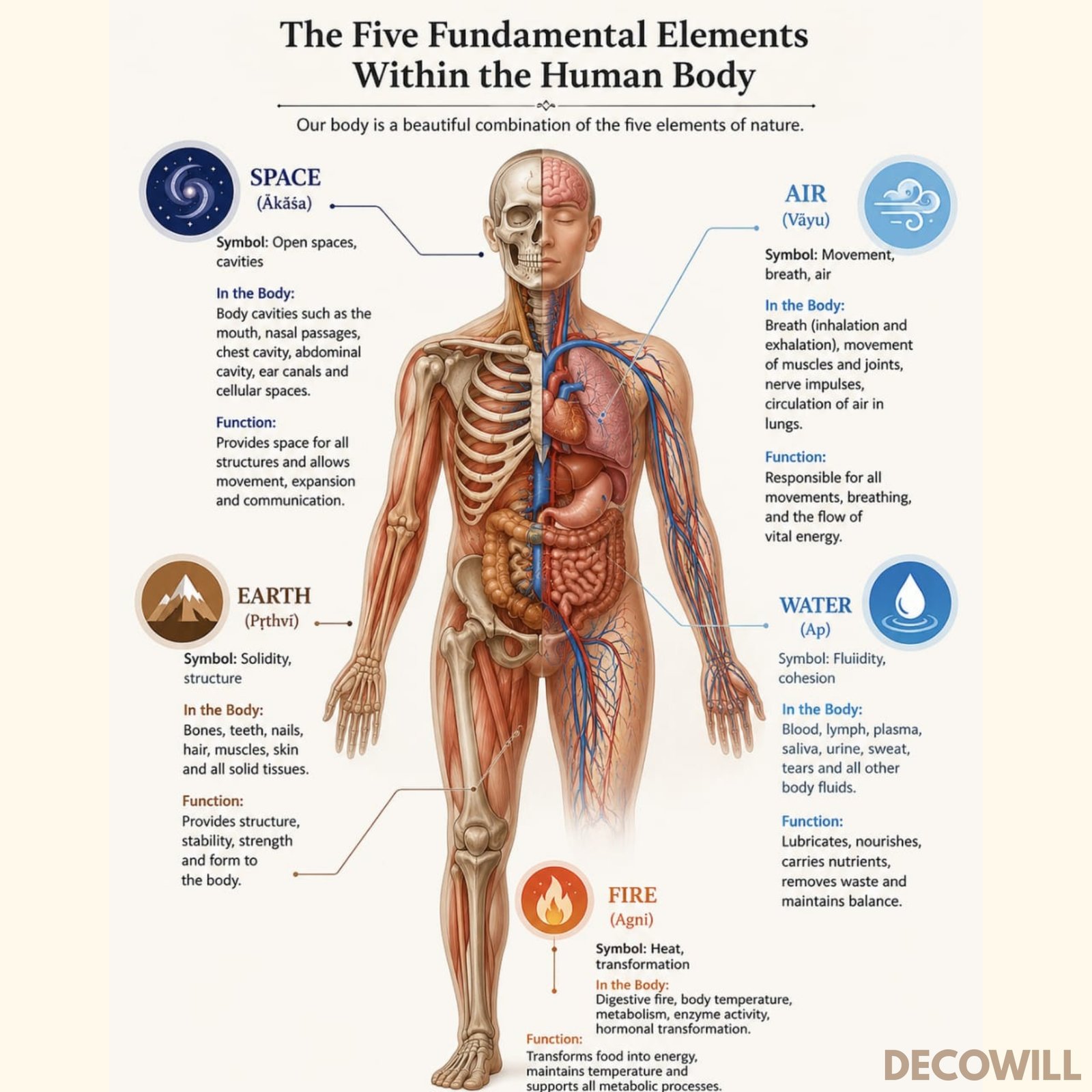
Thus, in Indian philosophy, the human body is regarded as a miniature cosmos, formed from the same fundamental elements that shape and sustain the universe.
Did You Know?
Modern astronomy tells us that many of the elements that make up our bodies, such as carbon, oxygen, nitrogen, and iron, were formed billions of years ago inside stars.
According to NASA and the European Space Agency (ESA), these elements were created through nuclear processes within stars. When those stars died, the elements they produced were scattered across the universe.
These same elements are also present within our bodies today.
In this sense, modern science reveals a profound connection between the human body and the cosmos.
Human Experience & Consciousness
Apart from the five fundamental elements, the five sensory organs also hold great importance within our bodies.
The five sensory organs are the gateways through which we experience the world.
Each organ is associated with a specific sensory quality and enables us to perceive a particular aspect of reality.
- Ear – experiences sound.
- Skin – experiences touch.
- Eye – experiences form, color, and light.
- Tongue – experiences taste.
- Nose – experiences smell.
Now an important question arises: What exactly do our sensory organs experience, and how are those experiences connected to the five fundamental elements?
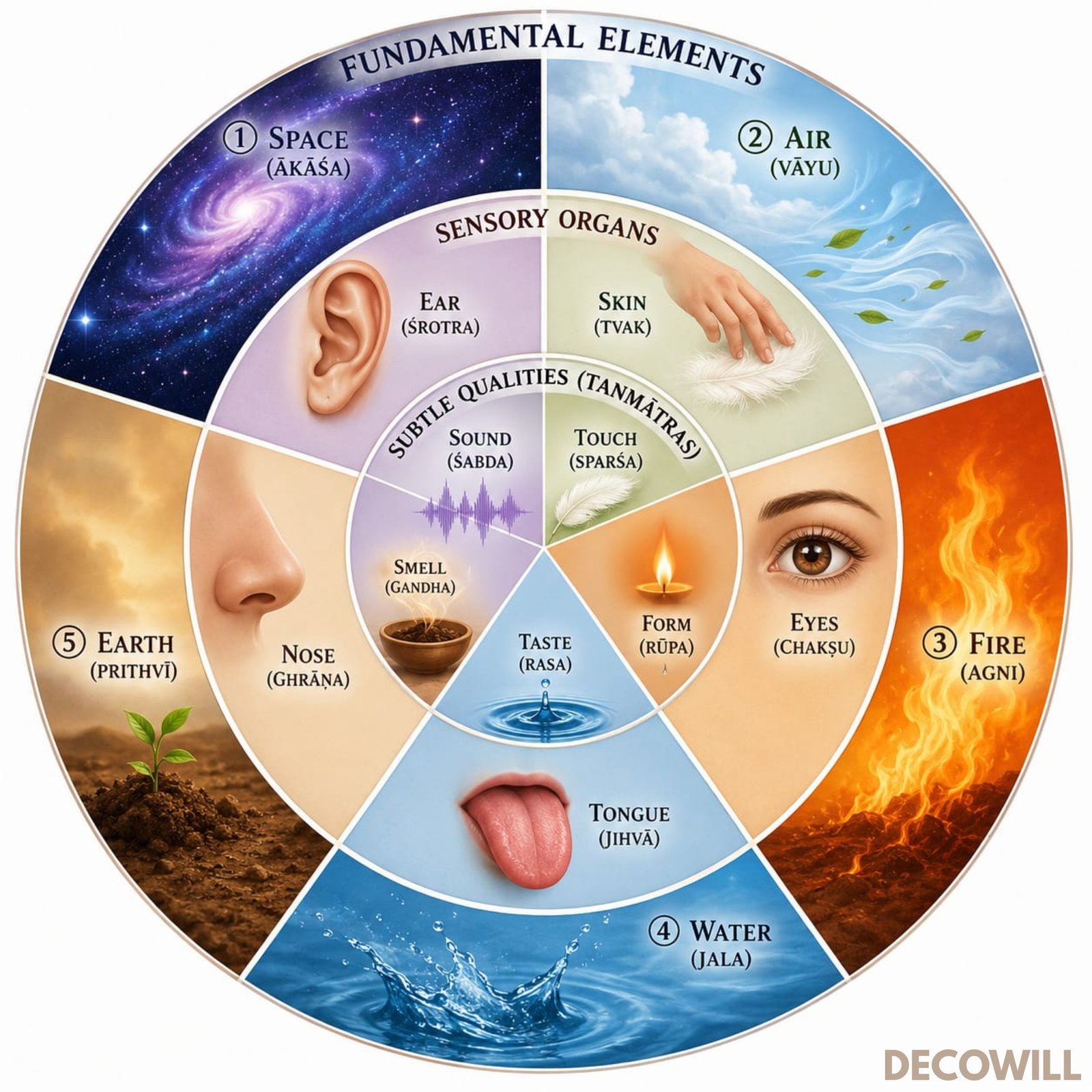
According to Indian philosophy, our sensory organs perceive five subtle qualities—Sound, Touch, Form, Taste, and Smell. These subtle qualities act as a bridge between the physical world and our conscious experience of it.
As we have seen earlier, each sensory organ is associated with one of these qualities.
The ear experiences sound, the skin experiences touch, the eye experiences form, the tongue experiences taste, and the nose experiences smell.
The next step is to understand how these five subtle qualities are related to the five fundamental elements.
Relationship Between Fundamental Elements and Subtle Qualities:
According to Indian philosophy, there is a fascinating pattern in the relationship between fundamental elements and subtle qualities.
As we move from Space to Earth, each successive element acquires an additional subtle quality, making it progressively more tangible and perceptible than the one before it.
It is as follows:
Space (Akasha): Space possesses only one quality—Sound. It can be heard, but it cannot be touched, seen, tasted, or smelled. Therefore, it is regarded as the most subtle of the five elements.
Air (Vayu): Air possesses two qualities—Sound and Touch. It can be heard and felt, but it cannot be seen, tasted, or smelled. Therefore, it is considered more tangible than Space.
Fire (Agni): Fire possesses three qualities—Sound, Touch, and Form. It can be heard, felt, and seen.
However, it does not possess the qualities of Taste and Smell.
Water (Jala): Water possesses four qualities—Sound, Touch, Form, and Taste.
It can be heard, felt, seen, and tasted. However, it does not possess the quality of smell.
Earth (Prithvi): Earth possesses all five qualities—Sound, Touch, Form, Taste, and Smell. It can be heard, felt, seen, tasted, and smelled.

Therefore, it is regarded as the most gross or tangible of the five elements.
Thus, we observe that an additional quality is added to each element as we move from Space to Earth. The more qualities an element possesses, the more gross and perceptible it is considered to be. For this reason, Space is regarded as the subtlest element, while Earth is considered the grossest.
The Philosophy Behind the Five Flames
According to Indian philosophy, the five flames of a Panchmukhi Deepak can be seen as a symbolic representation of the five fundamental elements that constitute both the cosmos and all living beings.
These elements are experienced through our five sensory organs and their associated subtle qualities—sound, touch, form, taste, and smell. Thus, the Panchmukhi Deepak is more than a ritual lamp.
It serves as a reminder of the profound connection between the cosmos, the human body, the senses, and conscious experience.
Panchmukhi Hanuman and the Five Divine Qualities
The Story of Hanuman’s Panchmukhi (Five-Faced) Form
According to a popular tradition associated with the Ramayana, Ahiravana (also known as Mahiravana) was the powerful ruler of the netherworld (Patala Loka) and is described as Ravana’s brother.
It is said that Ahiravana performed severe penance and sought the boon of immortality from Lord Brahma. However, Brahma refused to grant him absolute immortality.
Ahiravana then requested that his life force be linked to five lamps placed in five different directions.
He could not be killed unless the flames of all five lamps were extinguished simultaneously.
Since no ordinary being could extinguish all five lamps at the same time, Ahiravana believed himself to be invincible.
Some traditions also describe Ahiravana as a devotee of Goddess Kamakhya. Through her blessings, he acquired immense mystical and magical powers.
During the war between Rama and Ravana, Ahiravana used his powers to abduct Rama and Lakshmana and take them to Patala Loka.
There, he prepared to offer them as a sacrifice to Goddess Kamakhya.
When Hanuman discovered their disappearance, he descended into the netherworld in search of them.
During his search, he learned the secret of Ahiravana’s immortality. The demon could only be defeated if the flames of all five lamps were extinguished at the same moment.
Since the lamps were burning in five different directions, Hanuman assumed his Panchmukhi (Five-Faced) form. With five faces looking in five directions, he extinguished all five lamps simultaneously.
The moment the lamps were extinguished, Ahiravana lost his powers and became vulnerable. Hanuman then slew the demon and rescued Rama and Lakshmana.
For this reason, Panchmukhi Hanuman is regarded as a symbol of courage, protection, devotion, wisdom, and divine strength.
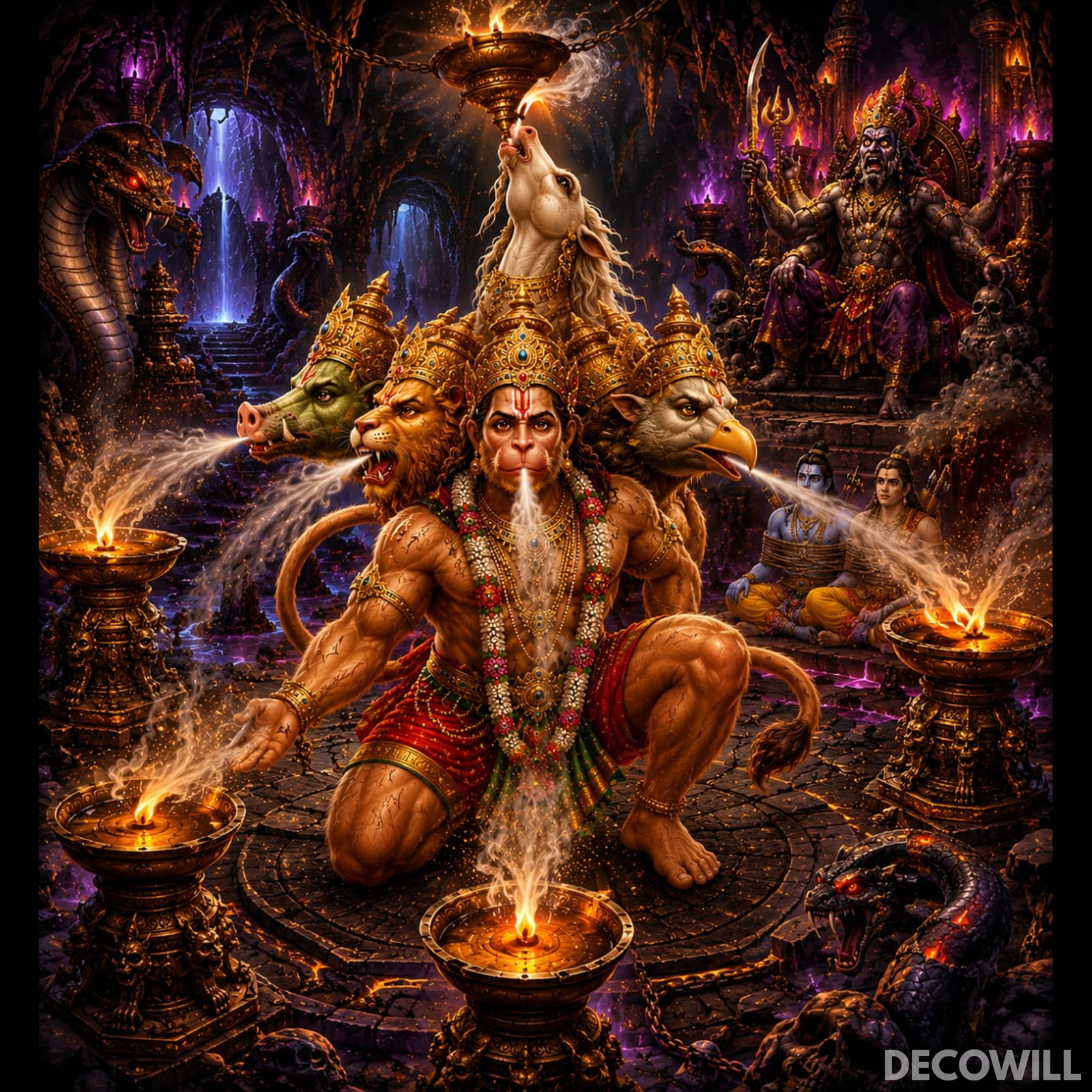
Five Faces, Five Divine Qualities
Hanuman assumed the following forms while manifesting as Panchamukhi (five-faced): Hanuman, Narasimha, Garuda, Varaha, and Hayagriva.
According to belief, the five faces of Panchamukhi Hanuman symbolize the following divine qualities:
Hanuman – Courage, devotion, strength, and selfless service.
Narasimha – Fearlessness, protection from evil, and righteous power.
Garuda – Freedom from obstacles, dangers, and negative influences.
Varaha – Stability, perseverance, and protection of the Earth.
Hayagriva – Knowledge, wisdom, learning, and spiritual insight.
Together, these five faces symbolize five divine qualities that help an individual lead a balanced and meaningful life. Courage gives us the strength to act, wisdom helps us make the right decisions, devotion keeps us grounded, protection gives us confidence, and perseverance enables us to overcome difficulties.
Devotees believe that by lighting a Panchmukhi Deepak, they receive the blessings of the divine qualities embodied in Hanuman’s Panchmukhi form.
Just as Hanuman protected Rama and Lakshmana from danger, devotees believe that he protects his devotees from difficulties, removes obstacles from their path, and helps them overcome the challenges of life.
Spiritual Symbolism and Daily Life
For centuries, the Panchmukhi Deepak has been lit with devotion in Indian homes and temples.
Many people believe that lighting this sacred lamp removes negativity and creates a positive atmosphere. Its gentle glow brings a sense of peace, purity, and spiritual comfort.
The Panchmukhi Deepak is also associated with the five fundamental elements and the deities connected with them.
By lighting the lamp, devotees seek their blessings and express gratitude toward the forces that sustain life.
The lamp reminds us of the deeper principles of Indian philosophy.
It symbolizes the connection between the cosmos, the human body, the senses, and conscious awareness.
Many devotees also associate the five flames with the five faces of Panchmukhi Hanuman. They believe that Hanuman blesses them with courage, devotion, strength, wisdom, perseverance, and spiritual insight.
The peaceful atmosphere created by prayer, meditation, and the soft light of the lamp can help calm the mind and reduce stress.
A calm mind often leads to a positive mood, emotional balance, and a greater sense of well-being.
For many families, lighting a Panchmukhi Deepak is more than a religious practice. It is a daily reminder to live with knowledge, gratitude, faith, responsibility, and inner strength.
Devotees also believe that Hanuman protects them from visible and invisible dangers, difficulties, obstacles, and unknown fears.
This faith creates a sense of security, confidence, and inner peace, helping them face life’s challenges with courage and optimism.
Thus, the Panchmukhi Deepak continues to illuminate not only homes but also the hearts and minds of those who light it.
Conclusion
The Panchmukhi Deepak is not merely a source of light. It is a symbol of the profound ideas that lie at the heart of Indian philosophy.
From the five elements and the five senses to the five divine qualities of Panchmukhi Hanuman, its five flames remind us of our connection with the cosmos, the natural world, and the potential within ourselves.
In this way, the Panchmukhi Deepak serves not only as a sacred lamp but also as a timeless symbol of harmony, responsibility, devotion, and
inner growth.
Decowill Panchamukhi Deepak
Inspired by India’s rich cultural heritage, Decowill is committed to preserving and celebrating traditional Indian values.
We offer premium-quality Panchmukhi Deepaks crafted from pure brass and designed for daily worship, festivals, and spiritual practices.